Add your promotional text...
How Location Detectives Work
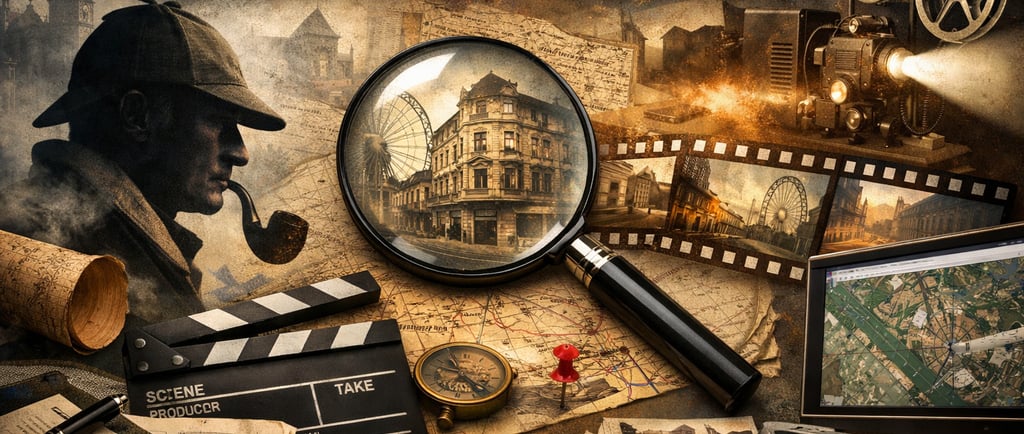
Finding a filming location isn’t just about spotting a landmark — it’s about reading the scene like evidence. Architecture, optics, archives, and geography all play their part. This is the method we use to turn cinematic puzzles into real‑world discoveries.
LOCATION DETECTIVE
A-Z LiteraTours
7/9/20263 min read
How Location Detectives Work
The method behind the mystery
Finding real filming locations is rarely as simple as matching a street name to a scene. Films compress distance, alter angles, build temporary façades, and combine multiple places into a single cinematic moment. A location that looks obvious on screen may be nowhere near where it appears to be.
This is where the Location Detectives come in.
Our work blends observation, research, historical context, and a healthy respect for the tricks of cinematography. Whether we’re tracking down a quiet pension in Vienna or identifying a seaside alley in Italy, the process follows a consistent investigative method.
1. Frame Analysis
Every investigation begins with the film itself. We examine the scene frame‑by‑frame, noting:
· architectural details
· window and door shapes
· street angles
· decorative elements
· background objects
· shadows and light direction
These details often survive decades of change and become our first set of clues.
2. Landmark Verification
Fixed landmarks — towers, hills, bridges, monuments — anchor the search. Even when façades change, landmarks rarely move.
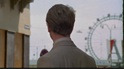
If a cathedral spire or Ferris wheel appears in the background, we map its orientation and distance relative to the camera. This helps us narrow down the possible filming area.
3. Historical Cross‑Checking
Cities evolve. Buildings are renovated, demolished, repainted, or repurposed.
We compare:
· archival photos
· historical maps
· old city directories
· production notes
· interviews and behind‑the‑scenes materials
This helps us understand what existed at the time of filming — and what no longer does.
4. Optical Interpretation
Cinematography can deceive the eye.
· Long‑focus lenses compress distance, making background objects appear much closer and larger.
· Wide‑angle lenses expand distance, making backgrounds appear smaller and farther away.
· Studio reproductions can mimic real landmarks with surprising accuracy.
Understanding these distortions is essential. A landmark that looks “right behind” an actor may actually be hundreds of meters away.


5. Geographic Triangulation
Once we understand the lens effects and landmark orientation, we triangulate the real-world geography.
We map:
· the angle of the camera
· the direction of the actor’s movement
· the alignment of façades
· the position of background objects
This often narrows the search to a handful of streets — or even a single block.
6. On‑the‑Ground Confirmation
When the digital investigation reaches its limits, we walk the streets ourselves.
A cornice, a balcony, a door handle, or a window frame can confirm a match instantly. Sometimes the building has changed — but not enough to hide its identity.
This is the moment when the detective work becomes real.
7. Final Verification
Only when:
· architecture
· orientation
· background alignment
· historical evidence
· and optical interpretation
all match, do we declare a location solved.
This is the detective work behind every A‑Z LiteraTours cinematic journey — and why our tours feel authentic, researched, and grounded in real places.
Where to See This Method in Action
Our investigation into the filming location of Pension Kleist in Vienna — a key scene from The Day of the Jackal — is a perfect example of this method at work.
You can read the full case file here: Location Detective: Tracking Down Vienna’s Elusive Pension Kleist (Click on the image to access the article) ➼
Get in touch
Note: Our Social Networks links will be available soon
Film stills appearing on A‑Z LiteraTours are reproduced solely for critical commentary and educational analysis under Canada’s fair‑dealing framework. All rights to the original works remain with their copyright owners.
Click on the image below to see Terms & Conditions:
Cinematic & Literary Travel Experiences by A‑Z LiteraTours